Our philosophy · Since 2014
Out of love for nature.
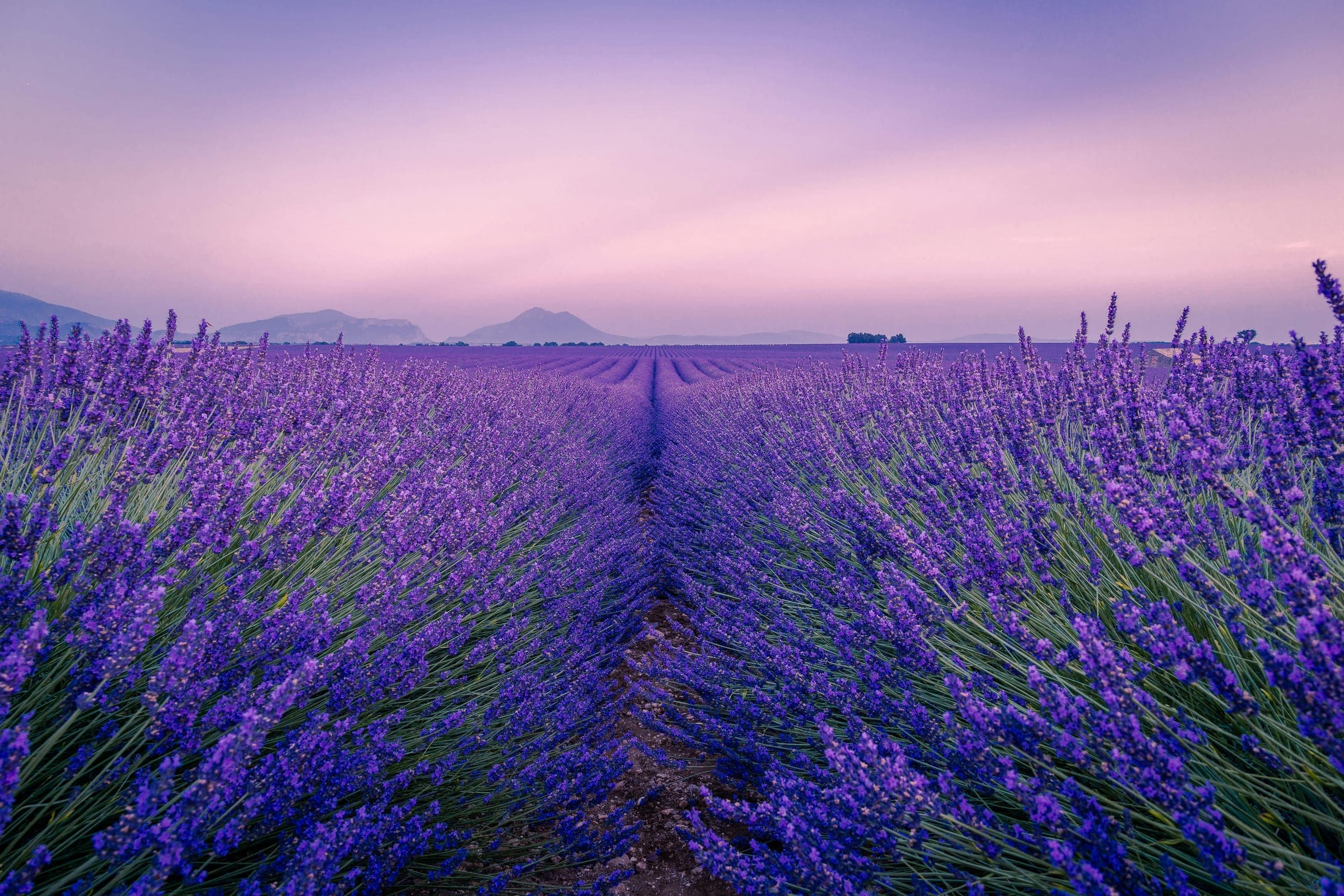
We started with four hectares in Geaca, a village of six hundred people in Cluj county, and one question: could a small Romanian producer hold itself to the evidential standard of a laboratory brand while growing its own raw material?
Twelve years later, the answer is a full range of formulas, a still four hundred metres from the field and a habit of publishing the mechanism behind every claim. We are not a large company and have no ambition to become one.
What we sell is a vegetal lipid base — butters, cold-pressed oils, our own hydrosols — carrying actives at the concentrations their studies used. Everything else on this site exists to explain that sentence.
Chapter I — The field
Four hundred
metres from
the still.
Lavandula angustifolia is a plant with a short temper. The two molecules that make it worth growing — linalool and linalyl acetate — start rearranging themselves the moment the stem is cut, and by the end of a hot afternoon the oil has turned sharper, more camphoraceous and markedly less gentle on sensitive skin.
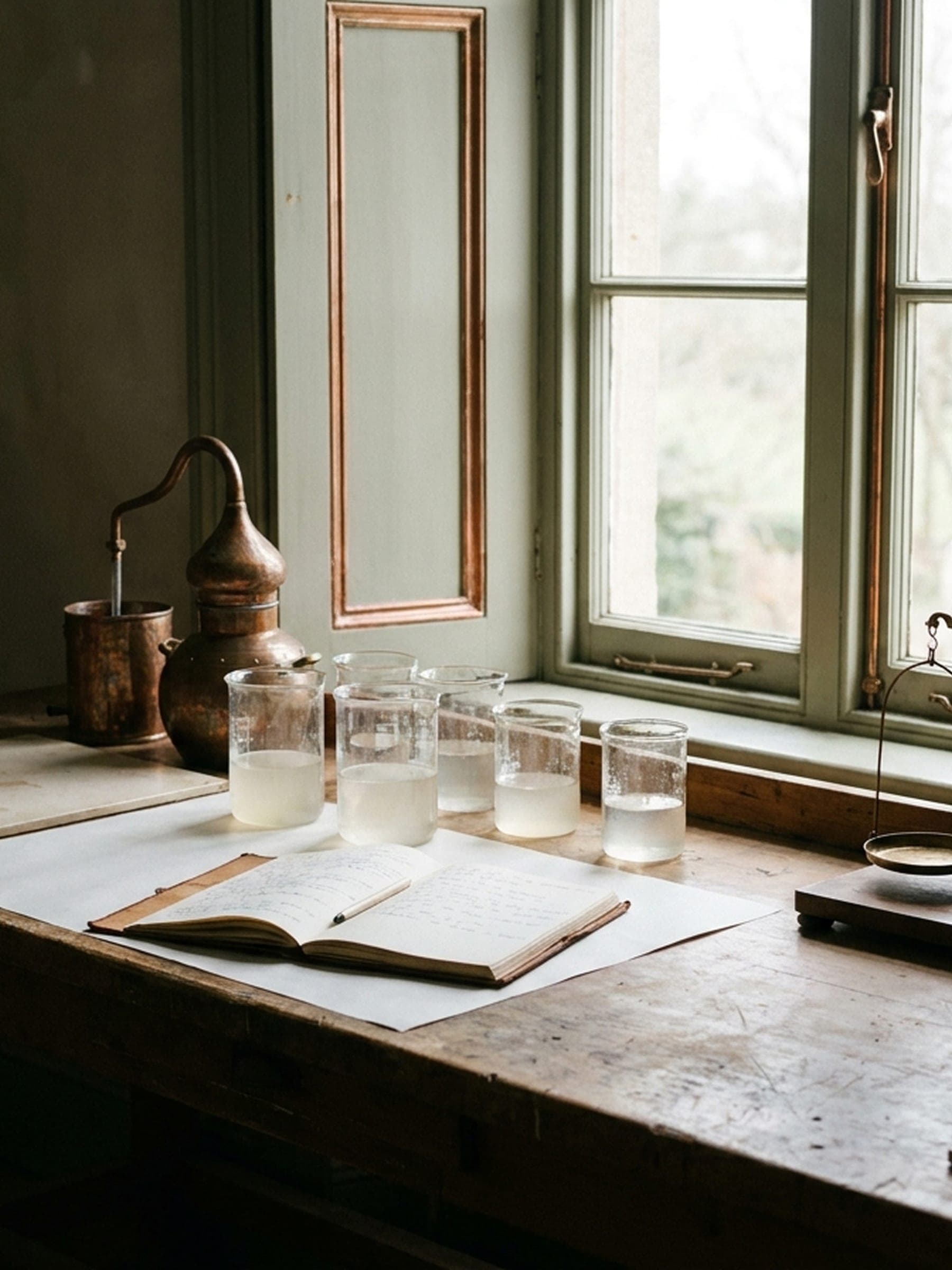
So we built the still where the lavender is. Cutting begins before six; the last load is in the alembic by noon. It is not a romantic decision. It is the only way to keep the chemistry we planted.
Geaca
Transylvania, Romania
4.2 ha
Planted 2014, picked by hand
6 h
Longest cut-to-still interval
11 kg
Essential oil per season
One morning, six steps
05:40 → 12:10, every day of the harvest
Cut
By hand, while the dew is still on the flower. Heat drives off the acetate before it ever reaches the still.
Sort
Stem and leaf out, flower in. Green matter dilutes the oil and pushes it towards herbal.
Load
Packed loosely. Compress the charge and the steam cuts channels instead of passing through.
Distil
Ninety minutes of low-pressure steam in copper. Faster is possible, and worse.
Separate
Oil off the top; the hydrosol underneath is kept, not discarded — it becomes the water phase of several formulas.
Rest
Six weeks in steel, in the dark, before any of it is weighed into a formula.
Chapter II — The standard
Four rules we do not negotiate.
We publish the mechanism
If we cannot say which structure in the skin an ingredient acts on, we do not put the ingredient in. Every claim on this site resolves to a barrier lipid, a signalling pathway, an enzyme or a measurement — and the Beauty guide exists to spell each one out at length.
We dose to the study
Niacinamide at four to five per cent, because that is where the trials sit. Hyaluronic acid at two molecular weights, because one does not do what the other does. An active present at a fraction of its studied concentration is label decoration, and we would rather leave the line blank.
We name the grower
What we cannot grow ourselves we buy on annual contracts from named farms, never on a spot market. An oil’s chemistry is decided by the season it came from; we would like to know which season that was, and so should you. The ingredient library lists the origin of every entry.
We do not promise what we cannot support
Our formulas are dermatologically tested, and the actives are chosen on the published studies for that ingredient. We do not put a benefit on the carton that we cannot support with documentation — and we do not present an ingredient study as though it were a finished-product test.
The exclusion list
What never goes
into the bottle.
Not because the word sounds bad. Because in a vegetal lipid base, each of these either does nothing useful or actively works against the formula.
- Parabens
- Effective preservatives, but redundant for us: our water phase is hydrosol at pH 5.0–5.5, with a food-grade system already validated by challenge test.
- Sulphates
- SLS and SLES lift the barrier’s own lipids along with the dirt. Our cleansers use sugar- and coconut-derived surfactants instead.
- Mineral oil
- Occludes well and feeds nothing. A barrier short of ceramides needs lipids it can metabolise, not a film it cannot use.
- Silicones
- A slip that flatters at the counter and gets in the way of everything applied underneath it.
- Added fragrance
- There is none in the range. What you smell is the distillate — which also means the scent changes slightly from harvest to harvest.
- Synthetic colour
- Our creams are the colour of what is in them. Sea buckthorn is orange; we let it stay orange.
- Animal derivatives
- The whole range is plant-based, and none of it is tested on animals — in the EU or anywhere we sell.
Chapter III — Sustainability
Small on purpose.
Growing your own material is the least glamorous form of sustainability and the only one we can fully account for. Beyond the field: glass and aluminium wherever the formula allows it, no secondary carton unless a regulation requires one, and a refill programme opening at the 2026 harvest for the six products that make up most of what we ship.
92%
Packaging recyclable at kerbside
0
Air-freighted ingredients
40 km
Field to filling line
2026
Refills, from the autumn harvest
Our story — twelve years
The first four hectares
Calantha S.R.L. registered in Geaca. Lavender and calendula planted between April and June.
The first eleven formulas
Face care only, sold at markets in Cluj-Napoca and by post. The anti-wrinkle cream dates from this year and has been reformulated twice.
The still
Copper alembic installed at the edge of the field. The cut-to-still interval falls from two days to six hours.
Instrumental testing
Twenty-eight-day corneometry and cutometry become mandatory for every new formula. Three products in development are abandoned.
Body, hands and hair
The range grows beyond face care. Men’s and teen lines are separated out for the first time.
The library, and refills
Every ingredient published with its origin and mechanism. The refill programme opens with the autumn harvest.
Compliance and company details
- Compliance
- Regulation (EC) No 1223/2009 on cosmetic products. Notified on the CPNP, with a safety assessment on file for every formula.
- Manufacture
- ISO 22716 good manufacturing practice. Small batches of two to three hundred units.
- Testing
- Dermatologically tested under supervision. No animal testing at any stage — by us or by our suppliers.
- Company
- Calantha S.R.L. · VAT ID RO32669608 · Trade Reg. No. J12/121/2014 · Sat Legii 222, Com. Geaca, Transilvania, România.